Selling Your Business: Rejoice, Regret or Remorse?
No-one wants to experience Founder Remorse.
However, the outcome of selling your business depends entirely on the readiness of the business and also on the emotional readiness of the founder. If either of these are at different stages of preparation, outcomes can vary considerably.
The optimal position to be in is to have a business that is ready for sale, or investors, and for the founder to have a personal plan for ‘what next’ once they step back from, or out of, their business.
If you design yourself and your business into this optimal position, you too can rejoice.
You need a plan to build value into your business that will give you options.
You also need a personal plan for what you will do next, and what will give you fulfilment.
Both are essential.
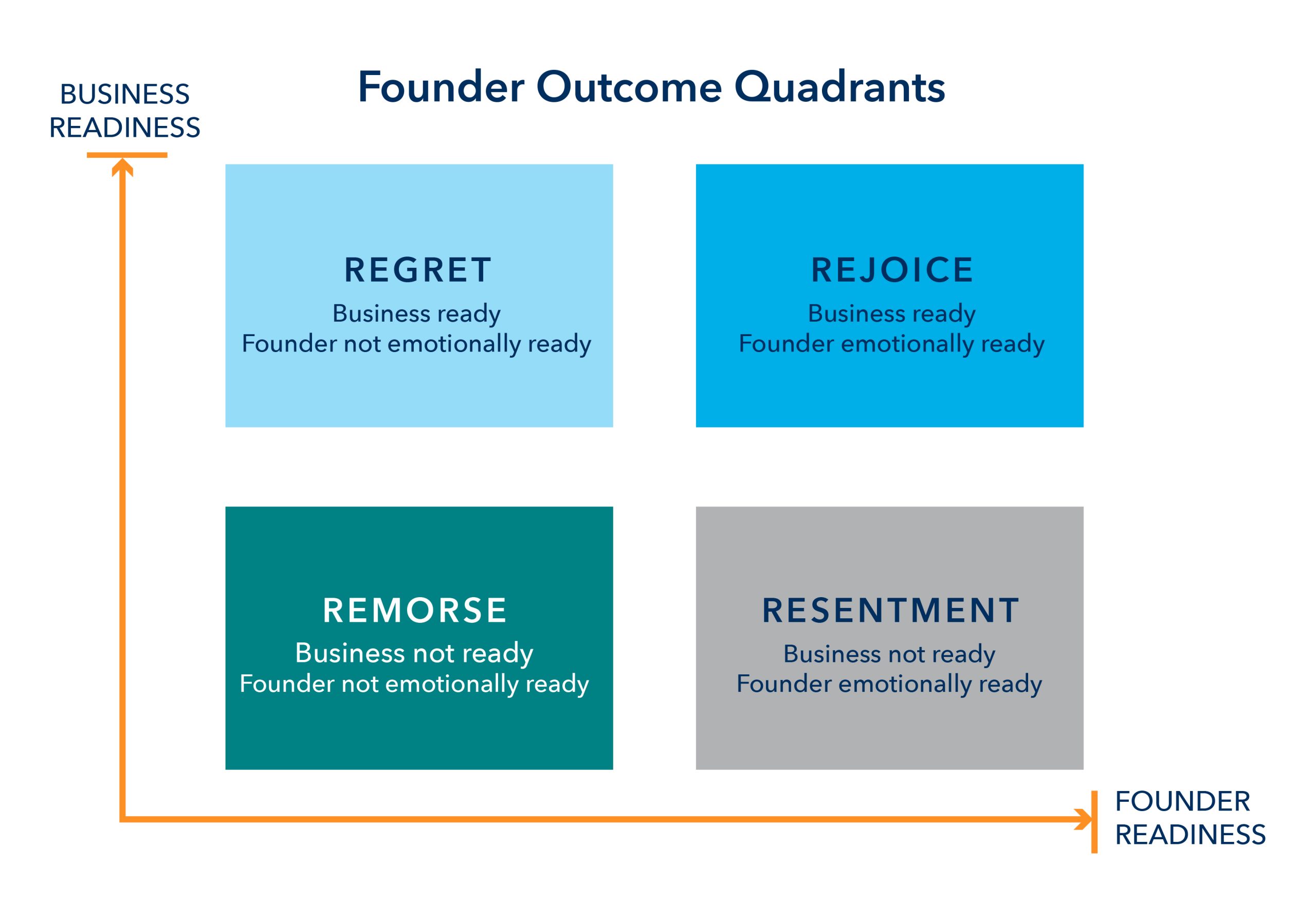
The Founder Outcome Quadrants summarise different outcomes depending on where the founder and business sit on the readiness scale.
Business Readiness
When the business is ready to be sold, and the founder has prepared for that, it will achieve a better outcome than if key pieces of the preparation process are missing. The business can be sold successfully when it is ‘ready’, regardless of whether the founder is emotionally ready to walk away.
Emotional Readiness
It is usually the emotionally ready founder who goes down the preparation path to strategically prepare their business for sale. If the founder is not emotionally ready to let go, they may neglect to prepare the business for sale, they struggle to let go, and they defer these decisions for too long. In many cases, the founder thinks they’re emotionally ready, until they have actually sold and left their business. That’s when regret starts to set in, at having left a part of their life behind.
Rejoice – Business ready / Founder emotionally ready
The optimal outcome is when the business and the founder are both ready and can navigate strategically through the preparation and ultimate sale of the company. This is an intentional strategy and when the time is taken to implement it properly, the outcome is an optimal one.
Regret – Business ready / Founder not emotionally ready
In so many well-documented cases, after the sale is concluded, within a year of exiting, founders feel a bit lost, and lacking purpose. They miss the interaction each morning with their team, they miss the relationships built with clients and industry peers over decades. They also miss having a reason to get out of bed and go somewhere in the morning.
As one founder has said to me “you have to have something else to do and you have to find another purpose”
Resentment – Founder ready / Business not ready
The founder is ready to sell. They think the business is ready – from their perspective. But the buyer still sees some gaps and potential downside in the readiness of the business to be transferred to a new owner. So we have a ready founder, but a business that isn’t quite ready.
The key risk for the acquirer is often the high level of dependence the business has on the founder as a rainmaker and primary contact point for the most valuable customer contacts. Inherent in those strong relationships is a risk.
The typical outcome is that the founder has to stay on in their business, reporting to their own business manager or sometimes to the acquiring company board, often for a two-year period. Not surprising that this creates resentment.
Remorse – Founder not emotionally ready / Business not ready
There are founders who talk about selling for some time, but do little preparation for that. This can go on for years.
But often, in the intervening years, the market changes, the competitor landscape changes, and the company’s sales can start to slowly decline. Even in these circumstances, founders can delay the decision to exit because they aren’t quite ready to leave the industry and the business they have been part of for decades.
The outcome is remorse, for not having taken a strategic approach to exiting, and waiting too long rather than preparing personally for an eventual exit.
After decades of dedication and effort to build a business, this has to be the worst outcome of all.
Preparation is the difference that will enable you to Rejoice.
Founders who walk away with rewarding exits, don’t do so by luck. They start preparing early and focus on building value into their business.
Here’s where to start:
Get your free sample chapter of Value First Exit Later, and learn the three levers of value to optimise your business now, and provide better future options.
Use the Value First Assessment to identify where your gaps might be, so you can start value building now.